
Missouri Age Verification Law: What Businesses Need to Know

The US legislative system has been on fire in the last few years, as age verification laws that aim to protect minors from harmful content online have been sweeping the nation. The last US state to jump on the age verification bandwagon is Missouri, with its new ambitious law, which businesses simply can’t afford to ignore.
The 25th state to join the age verification trend, Missouri’s Law is set to put guardrails on powerful corporations and shield children in Missouri from “devastating harms of online pornography”. For businesses, this translates into a legal and technical mandate to verify that your users are indeed adults.
In this article, we will break down the Missouri Age Verification Law, explaining its impact, defining compliance standards, and outlining the serious penalties for non-adherence – everything any business operating (especially producing content) online should know.
What is the Missouri Age Verification Law?
The Missouri age verification law, codified under 15 CSR 60-18 of the Missouri Merchandising Practices Act (MMPA), requires certain websites and applications to use “reasonable age verification methods” before granting users access to restricted material, especially graphic sexual content.
Part of Missouri’s “Online Safety” initiative, this law officially took effect on November 30, 2025, meaning that as of that date, adults in Missouri must prove their age to visit sites with adult material. The law outlines that if a platform’s publicly available content is 33% or more, aka “substantial portion”, of material that is “pornographic” or “sexually explicit” in a way that is patently offensive to the average adult community standard and lacks serious literary, artistic, political, or scientific value for minors, you must implement age verification.
Businesses that fail to age-gate adult content will be labeled as engaging in “unfair or deceptive practices.” And the websites that do not comply can face civil penalties up to $10,000 per violation per day.
“This rule is a milestone in our effort to protect Missouri children from the devastating harms of online pornography. We are holding powerful corporations accountable, respecting women and victims of human trafficking, and helping ensure that minors are shielded from dangerous, sexually explicit material,” said Missouri Attorney General, Catherine Hanaway.
The key takeaway here is that in order to stay compliant, businesses need a robust technical solution.
Who Must Comply with the Missouri Age Verification Requirements?
Even though the law’s primary target is explicit content platforms, the language is broad enough to impact a wider range of businesses, depending on how “harmful to minors” is interpreted.
This means that the primary targets are commercial websites and applications where a substantial portion (33% or more) of the content is sexually explicit or pornographic. So, we are talking about the following business categories:
- Adult content websites: pornography streaming sites, erotic image galleries, or any platform where one-third or more content is sexually explicit.
- Explicit content sections on larger platforms: main social media sites.
- Providers of erotic or pornographic content/media of any kind: video streaming sites, adult dating platforms, webcam sites, pornographic literature or comics sites, and certain online game platforms if their content is sexually explicit and crosses the 33% threshold.
- Search engines (partial compliance): must blur or disable any pornographic images, GIFs, or video thumbnails in search results pages for Missouri users.
- Mobile app and device ecosystem players: Apple and Google are explicitly compelled to provide a digital age verification interface in their OS platforms for use by apps and websites; for example, digital ID cards in Apple Wallet or Android’s equivalents. This suggests Missouri is pushing for a device-level age check solution, though the technology is still evolving.
But because the definition of “harmful” is rather vague, some experts warn of “mission creep”, suggesting the new rules could potentially affect lingerie/adult novelty sites, if product photos are deemed too explicit, as well as art/educational platforms, if they host classic works or educational content on human anatomy/sexuality.
What Counts as “Reasonable Age Verification” Under Missouri Law?
Simple checkboxes or “enter your birthday” fields no longer meet Missouri’s standard for age verification. The Missouri law requires businesses to rely on verifiable data and defines “reasonable age verification methods”, meaning you must take commercially reasonable, effective steps to actually confirm a user’s age.
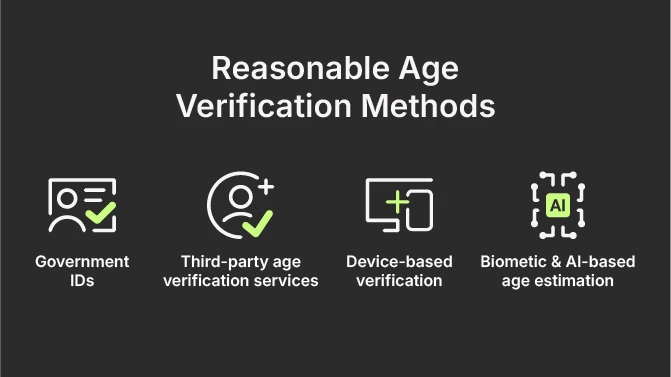
According to the new Missouri’s rule, a “reasonable age verification method” includes:
- Government-issued photo IDs: upload or scan a driver’s license, a state ID, or a passport.
- Third-party age verification services: use commercial age verification systems that rely on public or private transactional data, such as mortgage/credit records, employment records, educational records, or other identity databases.
- A digital identification card (device-based verification): digital ID or Wallets provided by a mobile operating system that would vouch for your age with a minimum amount of clicks, instead of uploading IDs. But this technology is not fully available yet.
- Biometric and AI-based age estimation: use alternative methods such as facial analysis technology (often combined with liveness checks) when AI algorithms analyze a selfie to estimate whether the person is over 18.
For example, an online adult content provider cannot just ask, “Are you 18?” and let the user click “Yes.” Instead, they must integrate a third-party age verification service that uses the user’s government ID or commercially available data sources to confirm the user is 18 or older.
It’s important to stress that the new Missouri age verification rules require businesses not to retain any personally identifying information after the age verification is performed and access is granted – all with the aim to protect user privacy.
How the Missouri Age Verification Law Works (Step-by-Step)
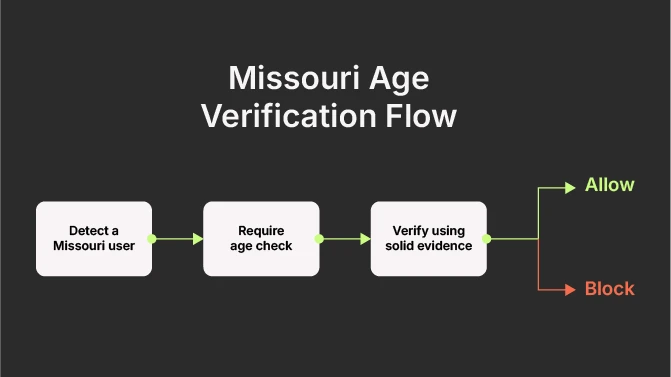
To clearly understand the flow of an age verification process stipulated in the new Missouri’s regulations, let’s walk through a simple step-by-step scenario of how compliance works in practice:
User attempts to access restricted content
A user initiates access to the platform by, say, navigating to the website, entering a URL, or opening the app. The platform then identifies that the user is trying to access content that is restricted to adults (18+). Next, the site will identify the user’s location, often via IP address geolocation or account information, and determine that Missouri law applies. At this point the user is not required to perform any action, it’s the site’s responsibility to initiate the age check.
As a business, you’ll need to implement such detection mechanisms that react to triggers like a geo-location and signal that an age verification flow is required.
Platform triggers an age verification step
Now, your system must immediately stop the user and trigger a mandatory age gate. This cannot be a simple honor-system checkbox, but rather a clear statement: “Age Verification Required. Must be 18+ to continue.” The next step is a re-direction to a third-party verification service or using an embedded widget on the site.
At this stage users may need to scan or photograph their ID, verify via digital wallet or by credit card – the flow depends on the age verification technology you use, and the actual flow sequence is not prescribed. The Missouri law only mandates that age verification must occur before access is granted.
Verification is performed using an approved method
The platform must integrate a third-party service or mechanism that uses an approved method, such as:
- Government ID scan: The user securely uploads an image of their ID.
- Transactional data check: The service uses non-identifying data points to confirm the user’s age against authoritative databases.
- Digital ID: (A future option) The user uses a secure, privacy-preserving digital ID provided by their device’s operating system to confirm they are an adult without revealing their actual date of birth or name.
For example, a third-party service that uses transactional data might ask the user for their name, address, and the last 4 digits of SSN, and then cross-check behind the scenes with credit records to infer age. If the data matches an adult individual, it approves. Or, a facial age estimation service might have asked the user to center their face on camera; the AI evaluates features and estimates an age range, for example, this person appears to be 20-25 years old, and approves because it’s confidently above 18.
Access is granted or denied based on the result
After you’ve deployed the required age verification tools and performed the age check for a Missouri resident, the next action is based on the age verification outcome.
Success: If the user is successfully confirmed to be 18 or older, the platform grants access. All identifying data collected for verification must be immediately deleted.
Failure: If the user is under 18 or fails to complete the verification, access must be permanently denied for that session or account.
It’s also important at this step for businesses not to store any personal data from the verification beyond what’s necessary. So ideally, after granting access, the site only keeps a non-sensitive marker (like “user XYZ verified = yes”) and does not hold onto copies of the user’s ID or other PII.
Penalties for Non-Compliance in Missouri
Missouri’s new law is not optional, outlining serious consequences for those that don’t comply. In fact, the Missouri Attorney General’s office is taking an aggressive stance on enforcement. Thus, violations of the age verification requirement are considered an “unfair, deceptive, fraudulent, or otherwise unlawful practice” under the MMPA.
Here are the actions that the Missouri Attorney General’s Office can take:
- Civil penalties. Violators can face fines of up to $10,000 per day for each day of non-compliance. This is a strong deterrent that can quickly accumulate for non-compliant platforms. So, avoiding the law can be very expensive.
- Attorney General (AG) enforcement. The Attorney General’s office can pursue legal action against violators. Practically speaking, the AG could file a lawsuit seeking an injunction to force the site to comply, along with civil penalties. The law casts violations as per se unfair trade practices, and Missouri’s Attorney General Hanaway publicly stated she would hold companies accountable and “will not hesitate” to enforce the rule to protect children.
“If these companies want to profit off explicit material in Missouri, they will not get a free pass. They must prove their users are adults or they will be shut out of our state,” said AG Catherine Hanaway.
- Mandatory corrective actions. Part of enforcement could involve requiring the business to implement compliant age verification measures by a certain deadline. Missouri’s rule doesn’t explicitly mention a cure period, so theoretically the AG could decide to warn first or might straightaway penalize. But practically, regulators will often send a letter outlining the violation and demanding corrective action, especially for first-time offenders or if the business appears unaware.
In response to the law, major adult content providers have already opted to geo-block all access from Missouri, demonstrating a willingness to sacrifice state revenue rather than comply with the stringent requirements and privacy mandates.
Business Impact: What Missouri Companies Need to Change
Compliance in general requires a significant overhaul of your security and data handling policies. So, if you operate an online business in Missouri or serve Missouri users, and fall under this law, you’ll need to make some operational and technical adjustments to stay compliant.
Website and Platform Updates
- Conduct a thorough audit to determine if 33% or more of your content falls under the state’s definition of “harmful to minors.” If you operate in a gray area, consulting with legal counsel is essential.
- Integrate a verifiable and robust Age Verification Solution (AVS) that meets the state’s requirement for government ID or commercial data-based checks.
- Implement accurate geo-fencing technology to block minors in Missouri from accessing restricted content.
Privacy and Data Handling Considerations
The biggest risk is the data collected during the verification process. Businesses must adhere to the law’s strict mandate: do not retain personally identifying information after access is granted.
- Minimize the amount of data you collect. Only keep the absolute minimum data required for verification.
- Ensure your AVS provider has a policy of immediate deletion of all government IDs, selfies, or other identifying personal data once the “age confirmed” result is delivered. Storing this information creates a massive security liability and is a direct violation of the Missouri law.
Parental Access and Consent Factors
While Missouri’s law primarily focuses on access to explicit adult content, the broader trend in other states (like Utah and Florida) includes requirements for parental consent and control over minors’ accounts on social media. Because the Missouri law focuses on the 18+ content, businesses should anticipate this requirement expanding and future-proof their systems to potentially handle parental consent flows for users under 18.
How Missouri Compares With Other US Age Verification Laws
Missouri’s law is part of a tidal wave of state-level age verification requirements, which currently span over 25 US states.
| State | Primary focus | Compliance methods | Key distinction |
| Missouri (15 CSR 60-18) | Commercial sites with ≥33% adult content | Gov ID, Transactional Data, Digital ID. | Highest fines ($10k/day); mandates mobile OS support for digital ID. |
| Louisiana (SB 162) | Commercial sites with ≥33% adult content | Digital ID (LA Wallet) or other “reasonable” means. | The pioneer AV state; first to implement; utilizes a state-specific digital wallet. |
| Utah (SB 287) | Commercial sites with ≥33% adult content | Gov ID or “commercially reasonable” data. | Private right of action; allows parents to sue platforms directly. |
| Arkansas (SB 66) | Commercial sites with ≥33% adult content | Gov ID, Digital ID, or NIST IAL2 standards. | High technical bar; references specific federal identity assurance levels (NIST). |
| Mississippi (SB 2346) | Commercial sites with ≥33% adult content | State-approved Digital ID or third-party services. | Focuses heavily on the use of authoritative databases (like credit bureaus). |
| Virginia (SB 1515) | Commercial sites with ≥33% adult content | Commercially available databases or face scans. | One of the first to go live; emphasizes flexibility in third-party tech. |
| Texas (HB 1181) | Commercial sites with ≥33% adult content | Digitized ID or commercial verification systems. | Requires sites to display specific health warnings about pornography. |
| Florida (HB 3) | Adult content platforms and social media | Gov ID or anonymous methods (for example, face scan). | Mandates anonymity; requires platforms to offer a no-data-retention option. |
| California (AADC) | Any service likely to be accessed by minors | Age estimation (AI/Biometrics) or high privacy defaults. | Design-focused; mandates “safety by design” rather than just a hard block. |
As you can see, there are a few shared patterns: The shared patterns are clear:
- Mandatory verification = Simple self-attestation is no longer an option.
- Strong enforcement = High fines, like Missouri’s $10,000 per day, and civil liability are becoming the norm.
- Privacy priority = Strict data deletion requirements are being included to mitigate the risk of mass data leaks.
This trend only highlights the need for a multi-state compliance strategy; i.e. the solution that works in Missouri should also be flexible enough to meet the requirements of Utah, Virginia, and others.
How Ondato Helps Businesses Meet Missouri Age Verification Requirement
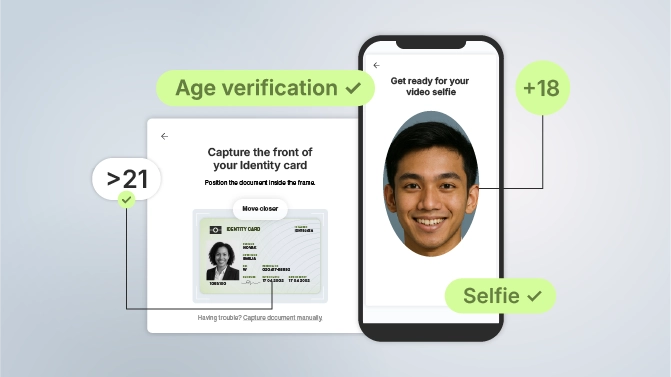
Implementing age verification is a technical hurdle that may feel daunting, but it doesn’t have to be a barrier to your business. At Ondato, we specialize in digital identity and age assurance and provide tools designed to help companies meet Missouri’s requirements with confidence and speed.
Document verification (high assurance)
Ondato automates the verification of government IDs – a method explicitly approved under the Missouri law. Using advanced OCR and fraud detection, the system validates passports or driver’s licenses in seconds, ensuring you meet the “reasonable age verification” standard without manual error.
To ensure an ID isn’t being misused by a minor, Ondato uses NIST-certified facial recognition and liveness checks. This confirms that the person behind the screen is the actual owner of the ID provided.
For a frictionless experience, Ondato’s OnAge solution uses AI to estimate age from a selfie without requiring any documents. This method is 100% anonymous; it verifies the user is 18+ and then immediately deletes the biometric data, perfectly aligning with Missouri’s strict no-data-retention mandate.
Verify once, use anywhere
Ondato issues a secure cryptographic token or PIN after a successful check. This allows users to return to your platform (or other participating sites) without repeating the identity verification process, reducing your long-term costs and keeping conversion rates high.
Privacy-first security
Built to GDPR standards, Ondato handles the heavy lifting of data protection. By using an external provider that doesn’t store sensitive PII, you eliminate the risk of attracting fraudsters that could lead to liability or breaches.
Seamless integration
With easy-to-implement SDKs and APIs, your team can deploy these compliance measures across web and mobile platforms with minimal code, ensuring a smooth user experience from day one.
In short, Ondato provides an all-in-one toolkit that bridges the gap between strict legal mandates and a great user experience.
Final Thoughts
The new Missouri age verification law is a powerful signal that tells the world that the US states are serious about online age controls and that they are prepared to leverage enormous fines and enforcement power to make it happen.
That’s why, for businesses, the time to adapt is now. Whether you are directly in the epicenter of the current law or on the periphery, the trend in the US is moving toward stricter age assurance for a wider range of platforms. Waiting until the last minute may end up in penalties and being geo-blocked by your own operational uncertainty.
So, prioritize robust age verification and absolute data deletion as you prepare for the future of online compliance.
FAQ






Comments
But what's going to happen if a website ignores Missouri's age verification mandate?
In this case fine can be imposed. Missouri Attorney General can sue for injunctions, daily $1,000 fines per violation, and up to $250,000 civil penalties, with no private lawsuits allowed.